The Death of Dogman: Linda Godfrey’s Greatest Fear

How a thriving cryptid community fell from grace, leaving its founders’ worst nightmares realized
For over two decades, Linda Godfrey has been the nation’s acknowledged expert on werewolves and contemporary sightings of unknown, upright canines. Her extensive research into the Michigan Dogman phenomenon, alongside Vic Cundiff’s Dogman Encounters Radio, established the foundation of what would become a passionate and dedicated community. Yet today, the very subject they helped nurture appears to be dying a slow, agonizing death—and it may be Linda Godfrey’s greatest fear realized.
The Golden Age
The Dogman phenomenon emerged from humble beginnings in the early 2000s. Linda Godfrey, a former award-winning newspaper reporter, became the nation’s acknowledged expert on werewolves and contemporary sightings of unknown, upright canines through books like “The Beast of Bray Road” and “The Michigan Dogman”. Meanwhile, Vic Cundiff created Dogman Encounters Radio to help eyewitnesses deal with the trauma of their encounters, providing a platform where people could share their experiences without fear of ridicule.
These two pioneers couldn’t have anticipated what they were unleashing. The community experienced explosive growth as more researchers and content creators joined the field. Names like Brenton Sawin emerged, while Dark Waters (James Williams) burst into the paranormal community in 2015, taking it by storm with his one-of-a-kind storytelling abilities. His charismatic presentations and unique narrative style brought countless new listeners into the field, making believers out of skeptics and expanding the community far beyond its Michigan origins.
The Peak
The Dogman community arguably reached its zenith with two landmark achievements. First came the revolutionary Dogman Cams project—an ambitious endeavor that placed live cameras in the woods, attempting to capture evidence of these elusive creatures in real-time. This technological approach represented a significant evolution from simple eyewitness accounts to active investigation.
Following this innovation came another historic milestone: the first-ever Dogman convention, with events like Paranormal Round Table’s Dogman/Cryptid Conference drawing crowds and selling out. These gatherings brought together researchers, witnesses, and enthusiasts from across the country, creating a sense of legitimacy and community that the field had never experienced.
The Metamorphosis: Creepypasta and Competition
However, success bred its own problems. The community began experiencing a series of troubling metamorphoses. Creepypasta narrators—content creators focused on fictional horror stories—began infiltrating the field, blurring the lines between genuine research and entertainment. This shift toward sensationalism diluted the serious investigative work that had built the community’s foundation.
Simultaneously, competition arose from Bigfoot loyalists determined to shut down anyone who talked about competing cryptids. The established Sasquatch research community, protective of their territory and resources, viewed the growing Dogman phenomenon as a threat. This rivalry created unnecessary division within the broader cryptozoological community, forcing researchers to choose sides rather than collaborate.
The Exodus: Dark Waters and the Void
The most devastating blow to the community came with the departure of key figures, none more damaging than Dark Waters’ exit from the cryptid field, with his final interview announced as “You just got my last interview about the cryptid field”. His charismatic ability to bring new listeners into the field through his unique storytelling had made him a flagship operation for the entire community.
When Dark Waters stepped away, he left a massive void that no other creator could fill. The community found itself without its most effective ambassador—the person who had convinced more people to believe in the subject than perhaps anyone else. Other content creators, both big and small, began abandoning the field, driven away by infighting, jealousy, and the constant drama that had come to characterize the community.
The ATM Machine Effect
Today’s landscape reveals a troubling trend among remaining podcasters and content creators. Many well-known figures in the paranormal space now treat Dogman content as what can only be described as an ATM machine effect. They post videos, punch in the metaphorical PIN number—D-O-G-M-A-N—and make their withdrawals in the form of views and revenue.
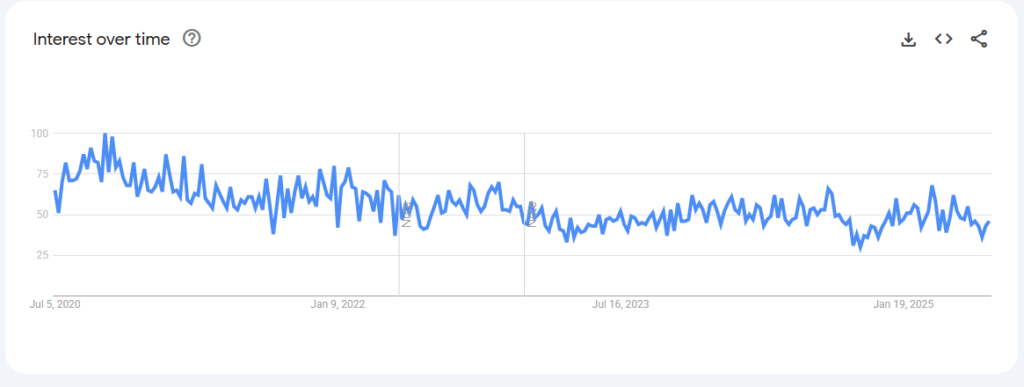
However, after witnessing the toxic drama that plagued the field, these creators refuse to dedicate their entire body of work to the subject. They’ll produce the occasional Dogman episode when they need content or revenue, but they won’t commit to being champions of the field. This opportunistic approach has further weakened the community’s foundation. Perhaps nothing better illustrates the current state of the Dogman phenomenon than what dominates Google search results for the term “Dogman.” Today, searches are increasingly overwhelmed by results for a plush doll based on a children’s book series, rather than cryptozoological research or eyewitness accounts. This shift represents a profound change in how the general public perceives and engages with the subject.
The five-year Google Trends data shows a clear downward trajectory for Dogman-related searches, indicating waning public interest. What was once a thriving field of genuine inquiry and investigation has been buried beneath commercial merchandise and children’s entertainment.
Linda Godfrey’s Nightmare Realized
For someone like Linda Godfrey, who spent decades building credibility and legitimacy around the subject of unknown canines, the current state of affairs must represent her worst fears coming true. Her careful, methodical approach to investigating and documenting sightings helped establish a foundation of serious research. She worked tirelessly to separate genuine encounters from hoaxes and to bring scientific rigor to a field often dismissed by mainstream academia.
The transformation of her life’s work into a fractured, drama-ridden community dominated by opportunistic content creators and overshadowed by children’s toys represents a betrayal of everything she sought to accomplish. The subject she helped bring into the light now appears to be fading back into obscurity—not due to lack of evidence or interest, but because of human failings within the community itself.
The Inevitable End?
The trajectory seems clear: a subject so loved by many dedicated researchers and witnesses is now on its way to nothing. The community that once showed such promise, that reached heights with live camera projects and sold-out conventions, has been decimated by internal strife and the departure of its most effective advocates.
Unless there’s a dramatic reversal—new leadership emerging, former creators returning, or a fundamental shift in how the community operates—the Dogman phenomenon may join the ranks of forgotten fads rather than serious cryptozoological inquiry. The algorithms no longer favor Dogman content, the general public associates the term with toys rather than mystery, and the remaining researchers struggle to maintain relevance in an increasingly crowded paranormal landscape.
The death of Dogman as a serious field of study would represent more than just the end of one cryptozoological pursuit. It would serve as a cautionary tale about how human nature—jealousy, ego, competition, and drama—can destroy even the most passionate and dedicated communities. Linda Godfrey’s greatest fear wasn’t that the creatures don’t exist; it was that the field she helped create would consume itself from within.
That fear, tragically, appears to be coming true.